
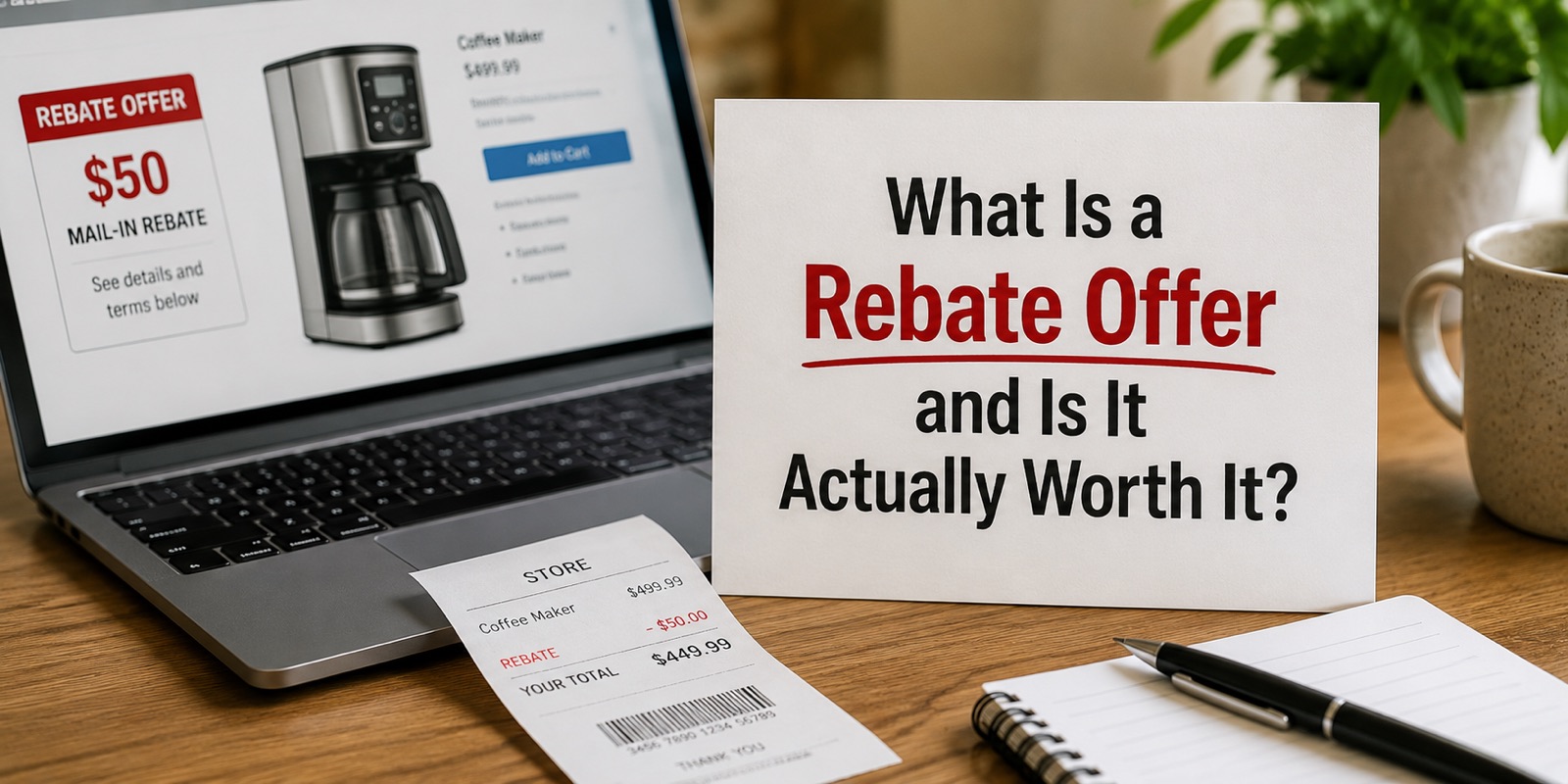
A rebate offer appears on a price tag, a product listing, or a promotional flyer, making a purchase look significantly cheaper than it actually is at checkout. Most shoppers have seen them. Few understand exactly how they work, and even fewer know that the friction involved in claiming one is not accidental. Here is what a rebate offer actually is, why so many go unclaimed on purpose, and how to decide when one is worth your time.
What a Rebate Offer Actually Is
A rebate is a partial refund issued after a purchase, not at the point of sale. You pay full price at checkout. Then, if you meet the eligibility requirements and complete the submission process within the specified window, the retailer or manufacturer will refund you a portion of what you paid.
That distinction, pay now, maybe get money back later, is the most important thing to understand about how rebates work. The advertised price with the rebate applied is not the price you pay. It is the price you might end up paying if everything goes correctly.
Rebates come in a few forms. Mail-in rebates require you to submit physical paperwork, a receipt, a UPC code, and a completed form by a specific deadline. Online rebates digitize that process but still require submission steps and documentation. Instant rebates are the exception: they apply at checkout automatically and function more like a discount than a traditional rebate.
For the purposes of this piece, when retailers advertise a rebate offer, they almost always mean the mail-in or online submission kind, not the instant kind.
Why the Friction Is There on Purpose
Here is the part most explainers skip. The submission requirements attached to rebate offers are not administrative necessities. They are intentional design decisions made to reduce the number of people who successfully claim the rebate.
This is called breakage in the retail industry. Breakage is the percentage of rebate offers that go unclaimed, and it is a revenue line that retailers and manufacturers explicitly plan for. The higher the breakage rate, the more a company can advertise a generous rebate offer without actually paying it out in full.
According to research cited by Consumer Reports, breakage rates for mail-in rebate offers have historically ranged from 40% to 60%. That means for every ten customers who buy a product because of a rebate offer, four to six of them never collect the money. The retailer keeps it. The advertised discount does its job of driving purchases, and a significant portion of the payout never materializes.
The short submission windows, the specific receipt requirements, the UPC codes that must be cut out precisely, the forms that must arrive by a certain postmark date: none of that is necessary to verify a purchase. It is there to create enough friction that a meaningful percentage of buyers give up, forget, or make a small error that disqualifies their claim.
When a Rebate Offer Is Actually Worth Claiming
Knowing the system is designed against you does not mean rebates are never worth pursuing. It means you should evaluate them with clear eyes.
A rebate offer is worth claiming when the dollar amount is high enough to justify your time, the submission process is genuinely simple, and the deadline gives you enough runway to complete it without stress. A $5 mail-in rebate on a $25 product with a 10-day submission window is rarely worth the effort. A $75 rebate on a $300 appliance with a 30-day online submission and a straightforward upload process is a different calculation entirely.
Before you factor a rebate into a purchase decision, ask these three questions:
- What is the actual submission process, and how long will it realistically take?
- What is the submission deadline, and do I have time to meet it comfortably?
- What happens if my claim is denied, and is there an appeal process?
If the answers are unclear or the process feels designed to be confusing, that is useful information about how likely the retailer is to pay out cleanly.
The Alternative That Does Not Require Any of This
The reason cash back platforms have grown significantly in popularity over the past decade is precisely that they remove every piece of friction that traditional rebate offers build in.
There is no form to fill out. No receipt to photograph and upload by a deadline. No UPC code to cut out and mail. No submission window to track on your calendar. You shop through a cash back portal; the purchase is tracked automatically, and the money posts to your account once the return window closes. That is the entire process.
RebatesMe has been running that model for 12 years across 3,000-plus partner retailers. The cash back earns whether you remember to check or not, because the browser extension catches the opportunity automatically when you land on a partner site. There is no breakage model working against you. The money either posts or, if a tracking issue occurs, there is a straightforward dispute process to resolve it.
It is not a rebate offer in the traditional sense. It is what a rebate offer would look like if it were designed to actually pay out every time.
How to Use This Knowledge at the Point of Purchase
Next time you spot a rebate offer, read the fine print before you factor it into your decision. Check the submission requirements, the deadline, and the eligibility terms. If the process is straightforward and the payout is worth it, claim it and set a calendar reminder for the same day.
If the process looks like it was built to wear you out, ignore the rebate entirely. A $200 product with a $50 mail-in rebate and a 40% claim success rate is realistically a $220 product, not a $150 one. Price it at what you will actually pay.
Either way, activate cash back through RebatesMe before you check out. It earns automatically and asks nothing of you after that first click.
A rebate offer is not a discount. It is a conditional refund with a process designed to reduce how often it is fully paid out. Understanding that changes how you evaluate every promotional price you see. Read the terms, claim the ones that are genuinely worth your time, and build the automatic cash back habit that earns money on every purchase without a form, a deadline, or a UPC code in sight.